
Why fine line work starts in the artwork file
On small medical housings, keypads, connectors and control parts, fine line work needs clean artwork from the start. Thin strokes can close up when the image is reduced for the plate, and small type can turn soft if the original drawing is not prepared for pad printing. At PadPrinters Medical in Westmead, Pinetown, we see this often with logos, scale marks, serial blocks and warning symbols where one weak line changes the whole readout.
Artwork Preparation is not only about making a file neat. It is about checking stroke weight, spacing, corner detail and how much detail can survive the plate and the pad. A redraw may be needed when supplied artwork comes from packaging, a web image or an old label that was never intended for a transfer print process.
- Keep line spacing generous where possible, especially around tiny text.
- Avoid hairline strokes that will fill in during ink transfer.
- Plan for the final part size, not just the artwork on screen.
- Allow enough contrast between marks and the base colour of the part.
Plate depth changes how much detail prints back
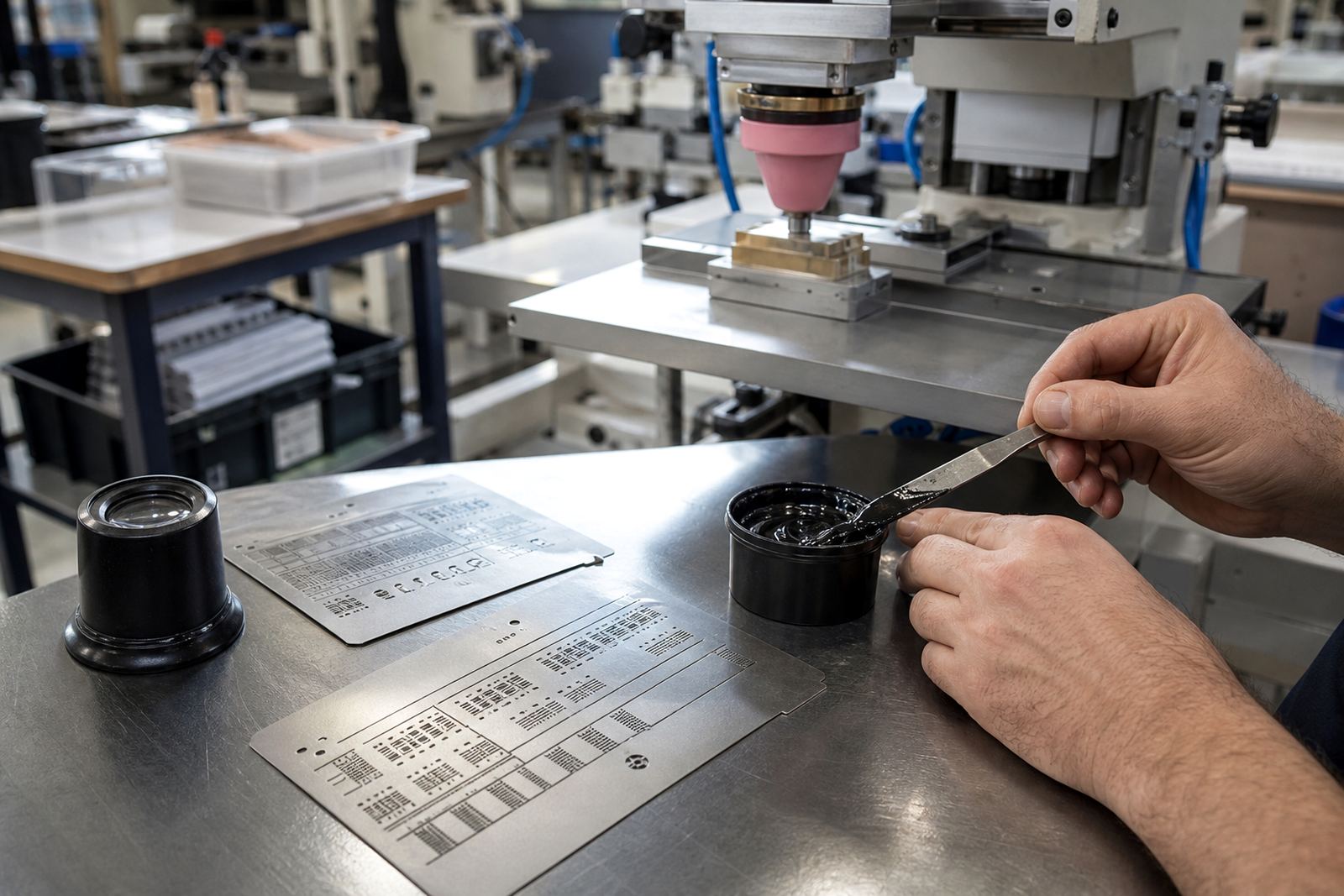
The etched plate controls how much ink sits in each cell. If the etch is too shallow, the line may print weak or broken. If it is too deep, the line can spread and lose its edge. For fine graduations and line work the balance has to suit the artwork and the ink body used on the job. That is why Plate Exposure and Plate Etching need to be matched carefully to the part.
Our team, led by Sibusiso Naicker with Naledi Kekana, Sanjay Dookhi and Lerato Mabunda, checks plate condition against the job outcome, then adjusts before a run is released. In practice this means the line can stay crisp without starving the image or flooding small areas with too much ink. A clear plate also helps with rerun job control when the same mark is needed months later.
- Shallow etch can suit very small text if the ink release is controlled.
- Deeper etch may help with stronger coverage on darker parts.
- Plate wear or damage can blur repeating fine marks.
- Trial sample runs show whether the image is holding detail before production starts.
Pad shape and hardness decide what the image can carry
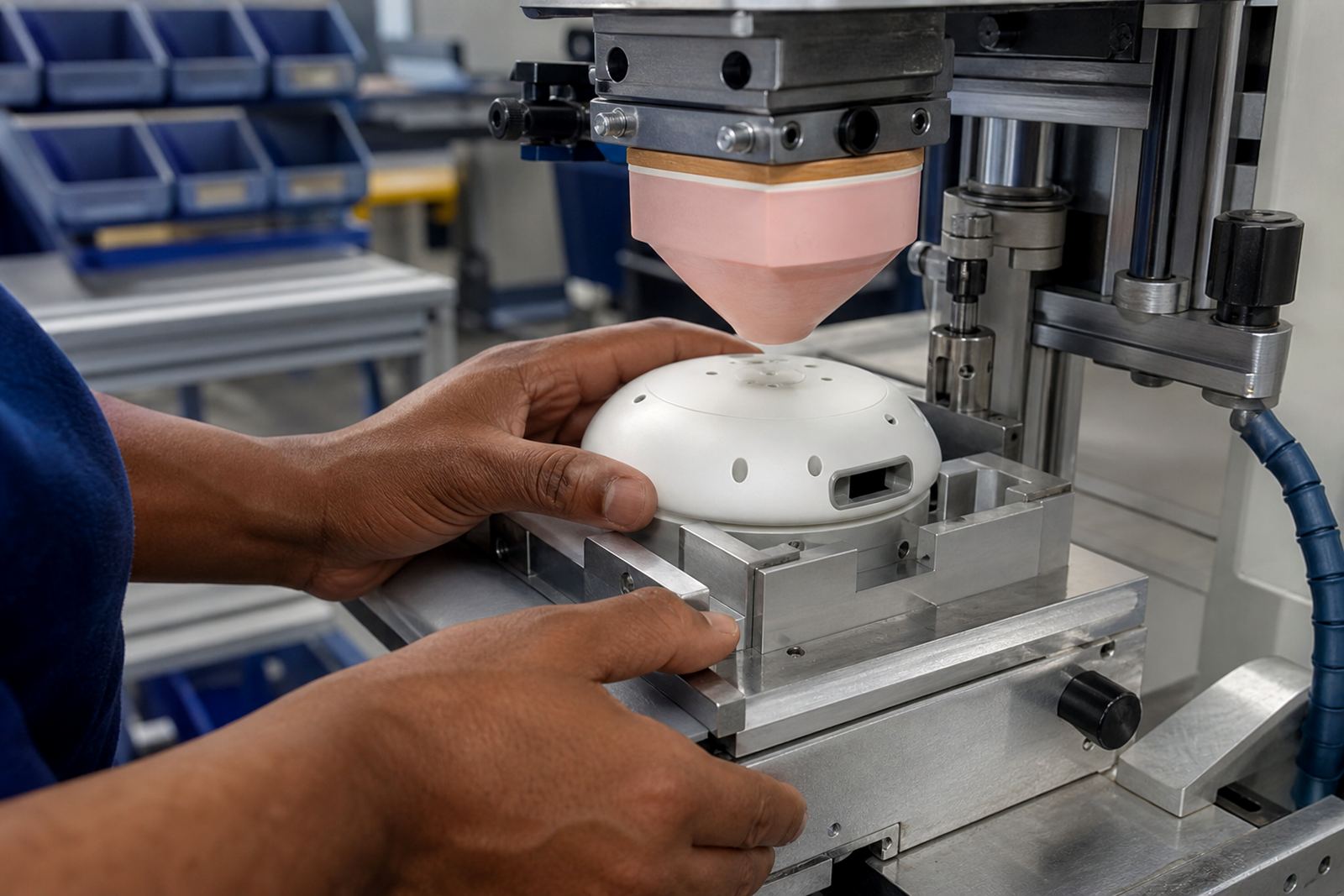
The silicone pad is what lifts the ink from the plate and places it onto the component. For fine lines, the pad must be able to pick up the full image and still release it cleanly on the contact area. A pad that is too soft may distort the mark on uneven parts, while one that is too hard may not conform enough to push ink into small recessed or curved features.
Pad choice is also tied to the part itself. A flat control face does not behave like a curved medical cap or a small electronic moulding with ribs and edges. Fixture Making is often part of the answer because the part needs to sit in a repeatable position while the pad lands in the same place every time. That matters when the line is only a fraction of a millimetre wide.
- Use a pad profile that matches the print area and shape.
- Check rebound so the pad releases cleanly, not with drag.
- Keep fixture location steady for repeatable line placement.
- Re-test the pad when the print begins to lose edge definition.
Ink choice and curing affect sharpness after transfer
Ink that is too thin can creep, while ink that is too heavy may not transfer evenly. The curing method also changes the final edge of the mark. Some parts need a quicker dry cycle, others need a longer controlled cure so the printed detail sets properly before handling and packing. On medical and electronic parts, that final stage is as important as the transfer itself.
Colour Matching is not only for appearance. It also affects contrast and legibility, especially where a light mark sits on a dark housing or a dark line must remain visible on a pale surface. In Durban and along the coast, humidity can alter drying behaviour, so the print room has to stay practical about ink flow and cure times. If the setup is rushed on a damp morning, the result can be soft edges and poor adhesion.
- Match ink to the substrate and the expected wear on the part.
- Use the right cure for the job, not a generic setting.
- Watch for humidity changes in coastal conditions.
- Run Adhesion Test Samples before larger batches move ahead.
Fine graduations need print area planning, not luck
Many clients ask for graduations, alignment marks or small reference lines on parts with very little flat space. That is where Print Area Planning becomes practical work rather than an afterthought. The image has to sit where the pad can reach it, the operator can check it, and the end user can still read it once the part is installed in a device or assembly.
For manufacturers in Johannesburg, Cape Town, Pretoria and Gqeberha, we often see the same problem in different forms: the mark is technically possible but not positioned for reliable production. A good plan takes into account gate marks, mould texture, handling points and the direction the part will face once fitted. It also helps with dispatch packing, because fine printed parts need care during transport to avoid scuffing before they reach the line.
- Leave space away from mould lines, vents and high wear points.
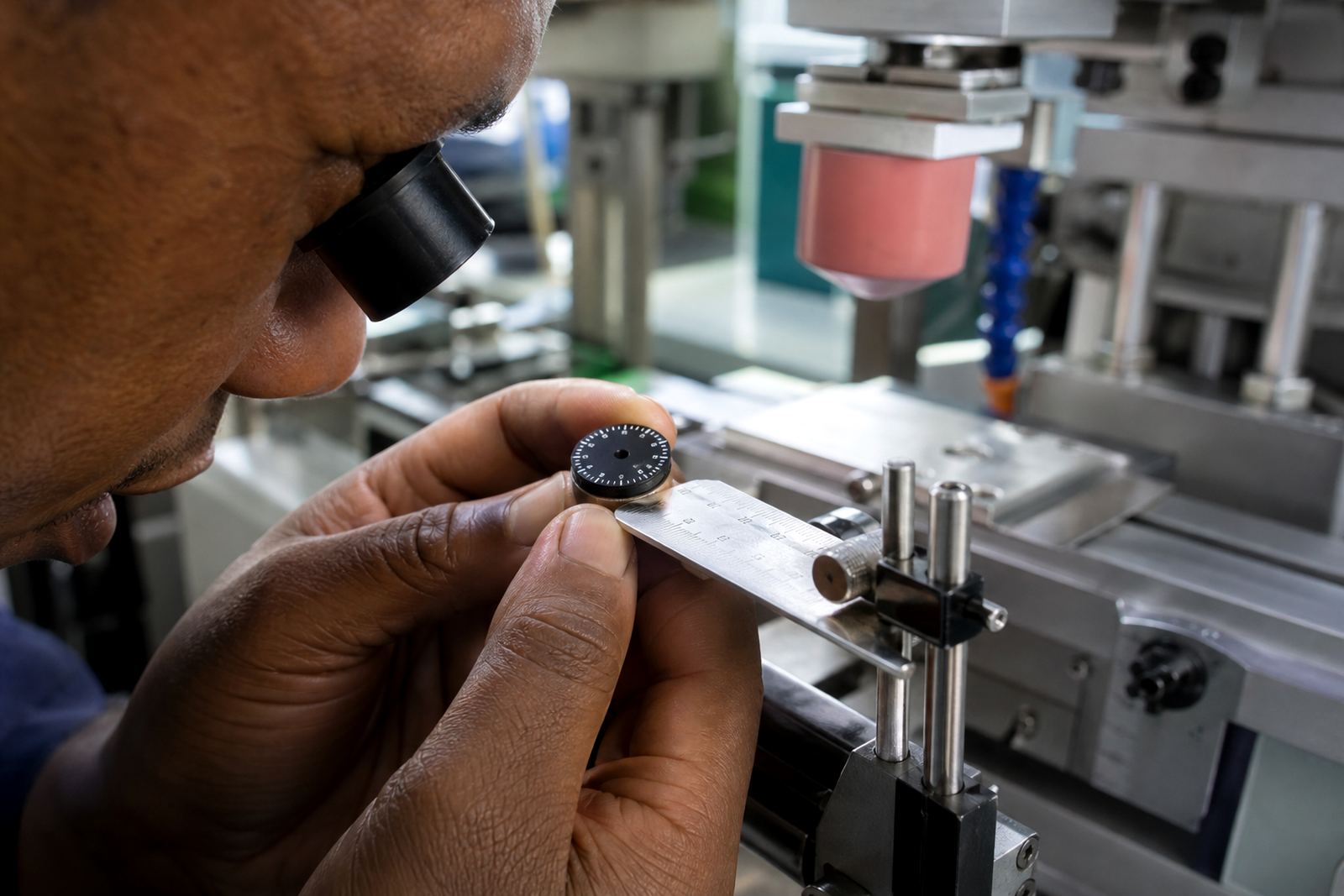
- Make sure the print can be inspected quickly by the production team.
- Think about how the part is handled after curing.
- Keep the same setup notes for repeat supply to different branches or sites.
A Westmead example: when a small line becomes a production issue
A medical device house in the Durban area once needed tiny reference lines on a pale plastic part used inside an assembly. The lines looked simple on paper, but the first samples showed one side printing heavier than the other. The issue was not only the ink. The plate depth was a touch off, the pad was too soft for the part shape, and the curing method was leaving the edge open too long before set. Once the artwork was adjusted, the plate re-etched and the fixture tightened up, the line returned to a clean even width.
That kind of job is common for customers across South Africa. Whether the order comes from Pinetown Printing Support, Durban Manufacturers, Johannesburg Supply, Pretoria Supply, Cape Town Supply, Gqeberha Supply, New Germany Support or Westville Support, the same rule applies: fine printing is built on controlled steps. The customer stays responsible for device compliance, but the print itself has to give them the best possible starting point.
- Start with trial sample runs before committing to volume.
- Use rerun job control so successful settings are not lost.
- Keep notes on plate depth, pad selection and cure method.
- Review the finished part under the same light used for inspection.