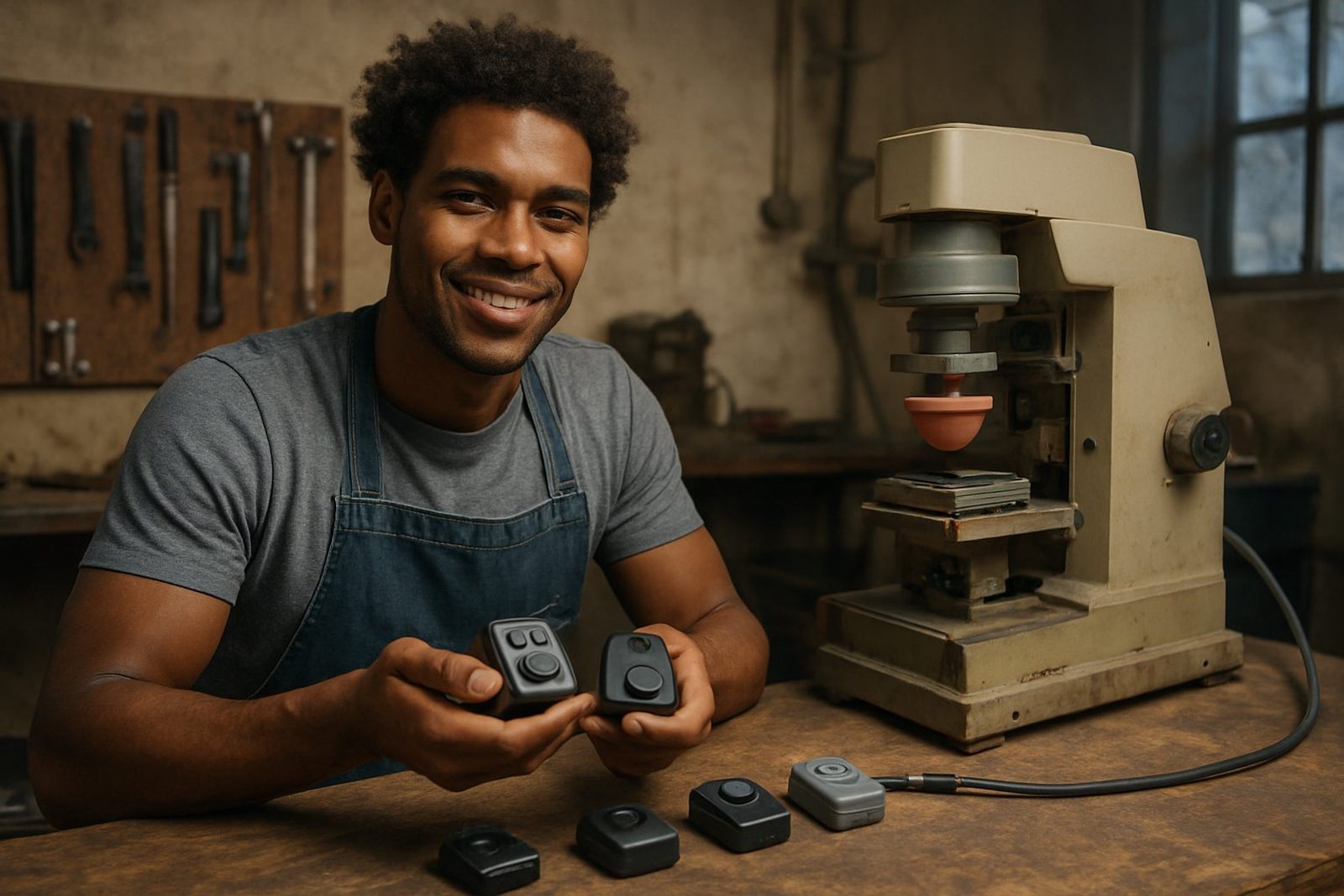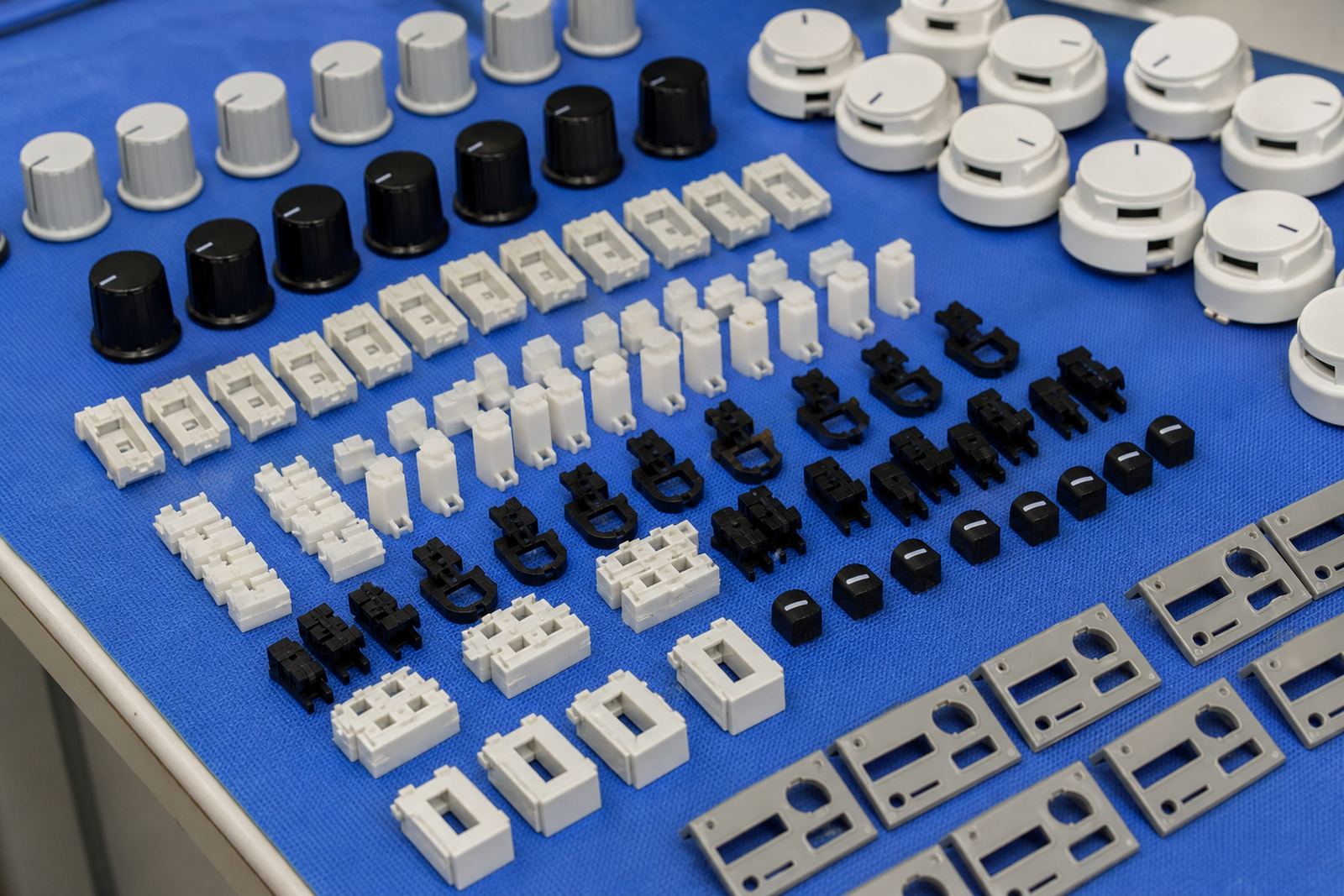

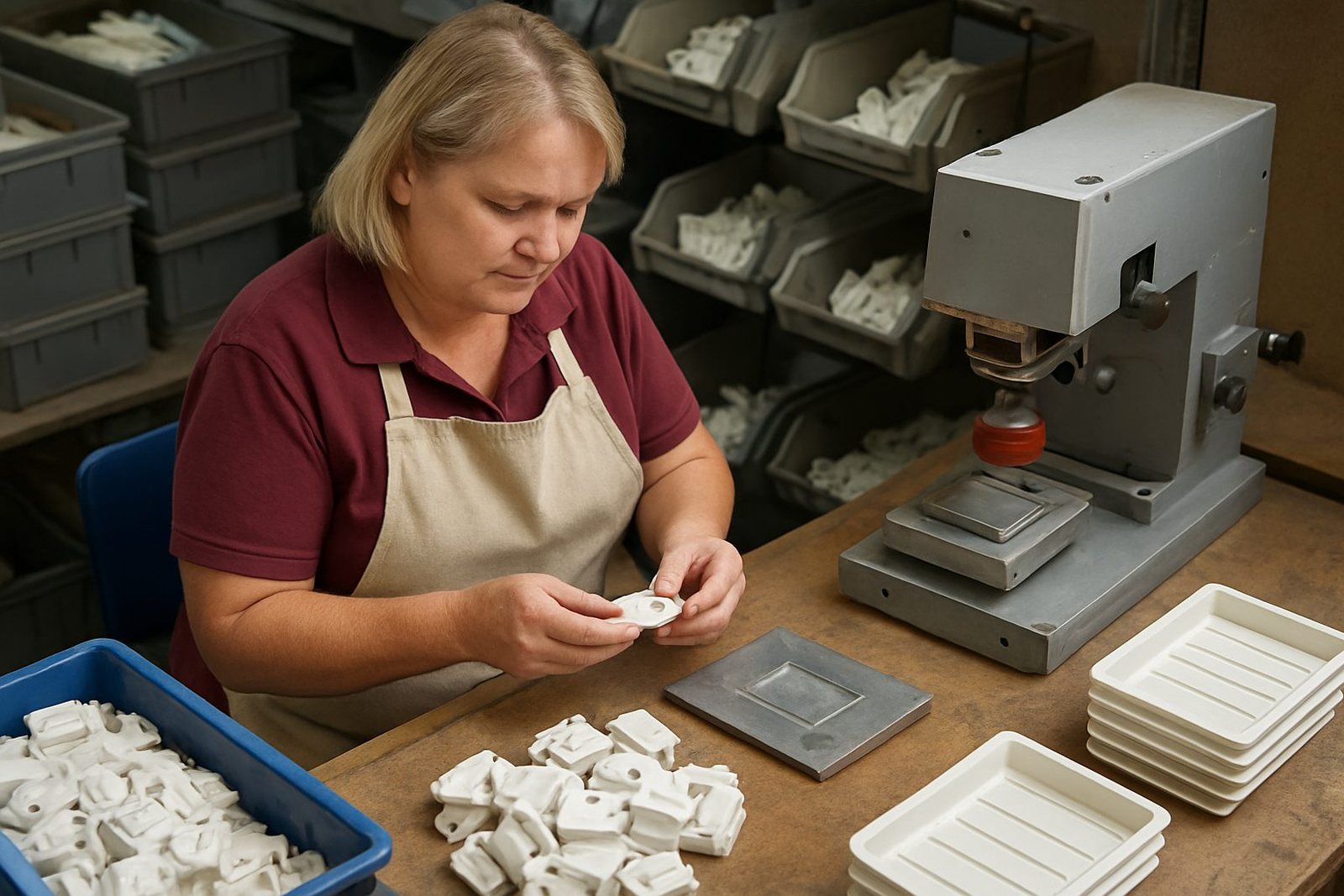
When Disposable Parts Need Clear, Fast Marking
Disposable component work is usually about repeat production, small print areas and a short product life. Think single use medical accessories, electronic housings, caps, tips, clips, trays and other parts that still need part numbers, logos, batch references or simple handling marks before they leave the line. The print must sit neatly on curved, textured or uneven surfaces, and it must do the job without adding much time to the cycle.
Pad printing suits this kind of work because the silicone pad can pick up ink from an etched plate and transfer it onto parts that are hard to print with other methods. Ink choice, surface prep and curing all matter. On some plastics the finish is straightforward, while on others a small change in mould release, dust or static can affect adhesion. For that reason we plan the job around the actual part, not just the artwork.
Typical Equipment Set For Disposable Component Jobs
Most disposable parts are printed on a compact set-up made for repeat handling and quick changeovers. The usual workflow includes artwork preparation, plate exposure, plate etching, fixture making, trial sample runs and then production with controlled curing. If the part is light or flexible, a simple fixture can stop movement and keep registration steady. For small parts, accurate jig spacing often makes the biggest difference.
- Silicone pad sized to the print area and part shape
- Etched plate matched to the logo or code layout
- Ink system selected for the base material
- Curing method chosen for the part and production speed
- Fixtures or nests for repeat positioning
- Visual checks for sharp edges, fill and placement
In humid coastal conditions around Durban, drying time can shift a little, and ink handling may need tighter control. That sort of thing is normal here, just part of running production in KZN.
Layout And Planning Advice For Single Use Parts
Disposable items are usually made in volume, so the layout has to support speed without losing consistency. Start by deciding where the mark belongs on the part and how the operator will load it. On small accessories, a logo that is too close to a curved edge can distort. On flat items, the issue is often not enough clear space for the pad to land cleanly. We look at orientation, grip points, stackability and whether the marking must be visible after assembly or packaging.
If the product has more than one variant, it is better to plan one common print area where possible. That reduces changeover and keeps artwork simpler. We also check whether the part needs a light pre-treatment, a specific ink cure, or a sample run before full production. For customers in Johannesburg, Pretoria, Cape Town and Gqeberha, good planning also helps with packing and dispatch because fewer reworks means fewer delays in transport.
- Confirm the exact print location before plate making
- Allow enough flat or stable area for the pad to land
- Keep artwork simple if the part is small
- Check stack height and packing so marks do not rub in transit
- Ask for trial samples before the full run starts
Common Mistakes On Disposable Component Runs
The most common mistake is treating every plastic or moulded part the same. Different materials accept ink differently, and even parts from the same mould can vary if there are residue, release agent issues or surface tension problems. Another common problem is asking for too much detail on a very small area. Fine text can look neat on screen but disappear once printed on a narrow curved surface. It is better to keep the mark practical and readable.
Another issue is poor batch control. If a job is restarted later without notes on pad pressure, curing time or ink mix, the next run may not match the first one. We keep rerun job control in mind from the start so later runs are easier to manage. For disposable parts, where the business may order in smaller lots but often, that makes a real difference. It also avoids wasted stock when a print starts lifting after the first heat cycle or after packaging.
- Using the wrong ink for the substrate
- Placing the mark on a curved or oily surface without testing
- Overcrowding the artwork with too much text
- Skipping trial samples before production
- Ignoring curing time before packing
Budget Ranges For Disposable Component Pad Printing
Budget depends on the part shape, the number of colours, the size of the print area and how much setup is needed. A simple one-colour disposable part with an existing layout will usually cost far less than a new job that needs artwork redraws, fresh plates, fixture making and sample approval. If a client needs multiple variants, each extra setup adds time and material cost.
As a practical guide, small trial runs and setup work can start from a few hundred Rand for very simple jobs, while more involved production preparation can move into the low thousands of Rand once fixtures, sample runs and plate work are included. Ongoing repeat production is usually more economical when the same part returns on a steady schedule. We quote according to the actual component and the marking requirement, not a standard one size fits all rate. That keeps the numbers honest and easier to plan around.
Before sign-off, it is wise to finalise all marking requirements because customers remain responsible for their own device compliance and product approval. We can help with the print side, but the product decision sits with the manufacturer.
The print room crew in Westmead
From our base in Westmead, Pinetown, we support disposable component marking for manufacturers across South Africa, including Durban, Johannesburg, Cape Town, Pretoria and Gqeberha. The team handles artwork preparation, logo redraws, colour matching, adhesion test samples, plate exposure, plate etching, fixture making, trial sample runs, curing method selection, rerun job control and dispatch packing. Sibusiso Naicker leads the business as Managing Director, with Naledi Kekana on production, Sanjay Dookhi on artwork and plates, Lerato Mabunda on quality, Yashika Sewpersad on client services and Mfundo Xaba on machine setup.
For clients in nearby areas such as New Germany and Westville, local support can speed up sample approval and job changes. For larger manufacturing runs, especially where disposable parts move straight from print to pack, it helps to keep the enquiry brief accurate with part photos, material details and the required print position. That keeps the first sample closer to the finished job, and saves time on follow-up changes.
- Good for single use medical accessories and electronic parts
- Suitable for short runs, repeat runs and variant packs
- Useful when the mark must survive handling, packing and transit
- Works best when part details are clear before plate making