
Where appliance control markings must hold up
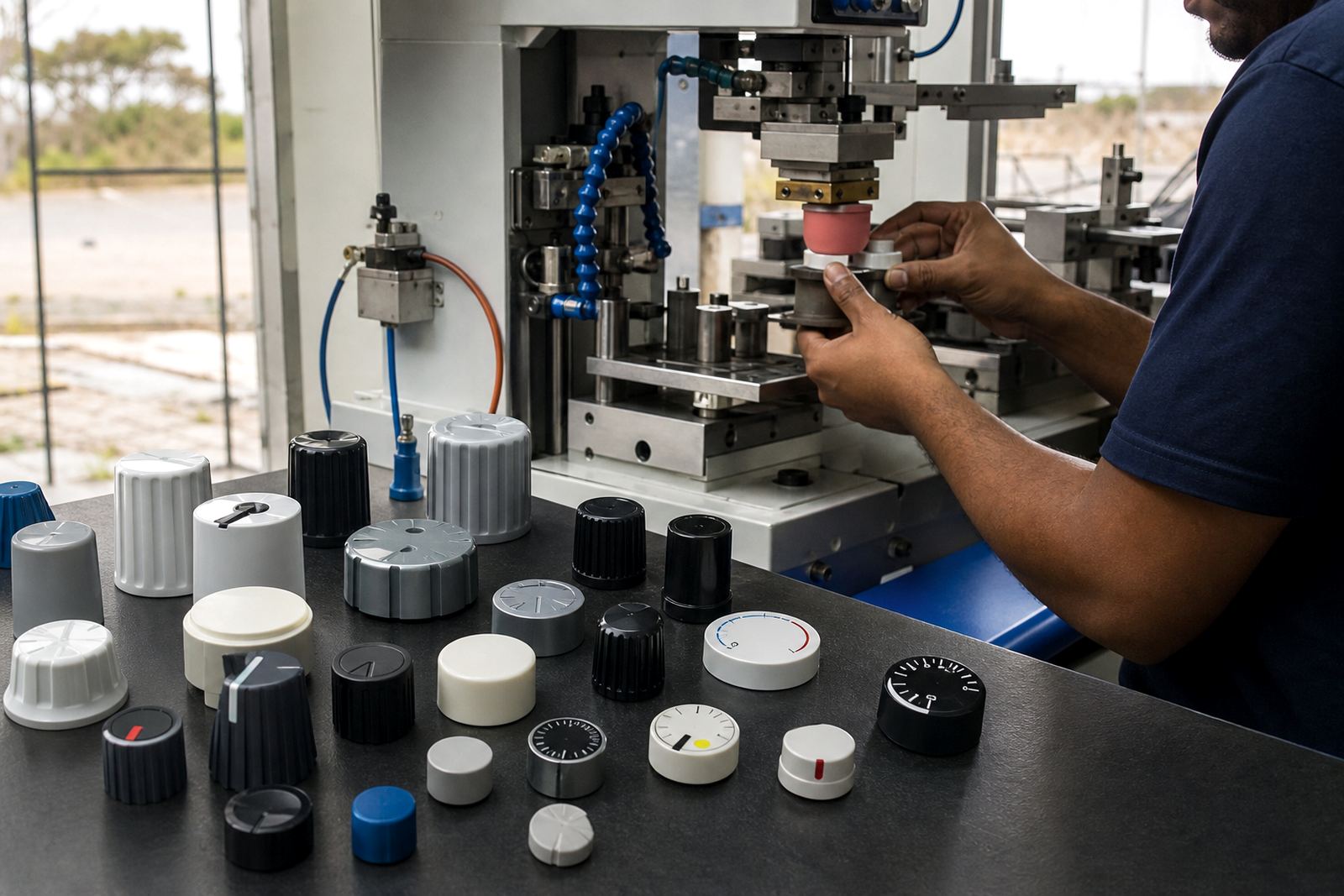
In appliance builds, the printed mark is often the last thing a user sees and the first thing they rely on. That includes temperature marks, on and off symbols, speed settings, programme numbers, warning icons and alignment dots on control knobs, push buttons and rigid front panel pieces. Pad printing is well suited to these parts because a silicone pad can pick up fine detail from an etched plate and place the ink onto curved, recessed or uneven surfaces with good repeatability.
For appliance control parts, the brief usually comes down to clarity, touch resistance and colour contrast. If a knob has a glossy moulded finish, the ink system and surface prep matter just as much as the artwork. Some parts need a simple single-colour legend, while others need a multi-step scale, small text or a fill that lines up with a pointer moulding. In practice, the earlier the markings are planned, the fewer problems you get later on the line.
Typical parts we print for controls and interfaces
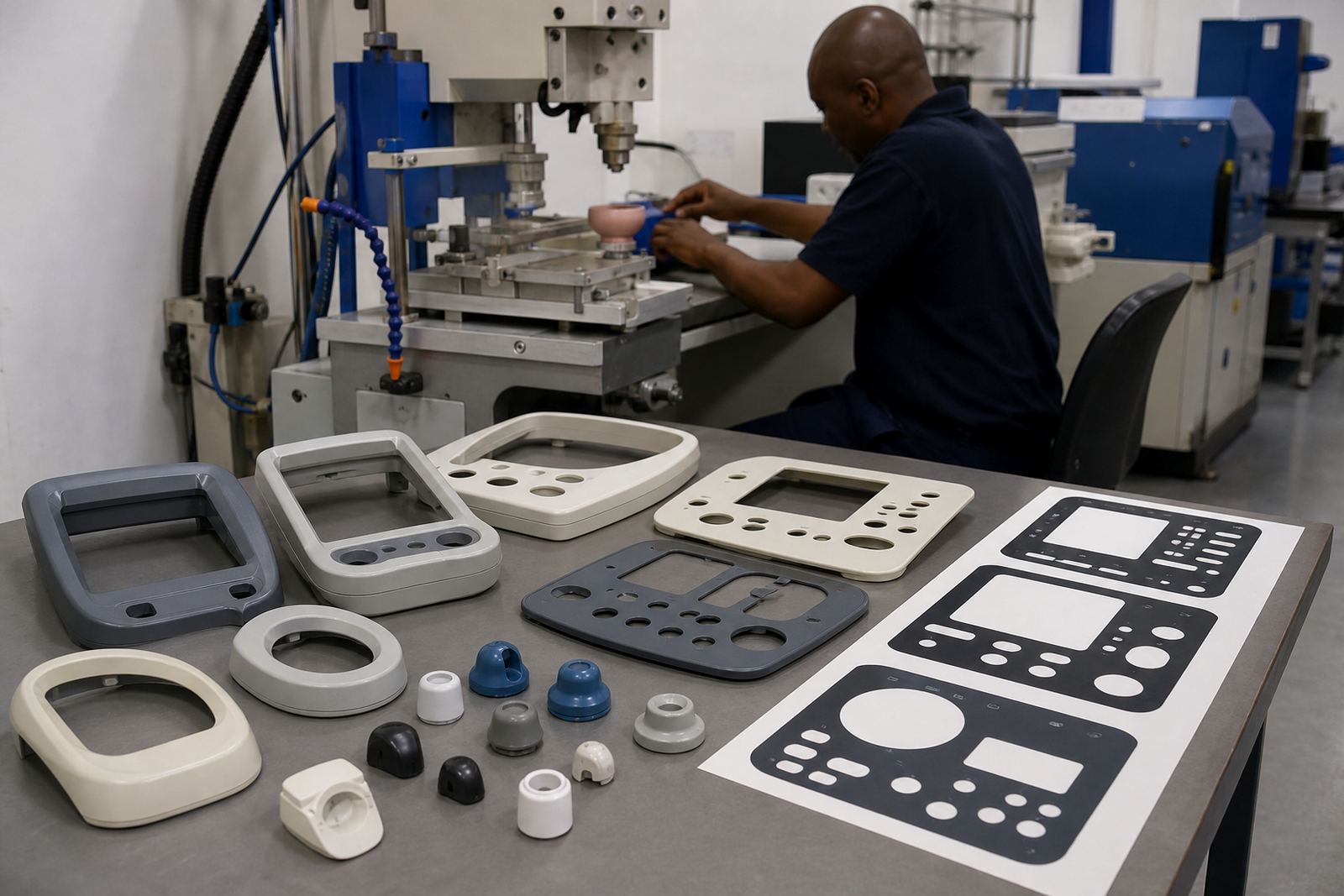
We work on rigid components used in white goods, small appliances, industrial panels and other control systems. The most common parts are moulded plastic knobs, selector rings, button caps, switch surrounds and small fascia pieces. Some are flat, some are slightly domed, and some have a narrow print window where the legend must sit cleanly without creeping over the edge.
- Temperature, timer and speed knobs with scale marks
- Power buttons, cycle buttons and symbol caps
- Control rings and pointer markers
- Rigid overlay pieces and front panel inserts
- Small legends for appliance sub-assemblies and control modules
For many customers, the challenge is not only printing the mark but keeping the part consistent across repeat runs. A control part that changes by even a fraction of a millimetre can throw off the alignment of the printed legend. That is why we pay attention to the mould, the fixture and the part orientation before the first sample run. If the part is not sitting the same way each time, the print will drift and the job becomes hard to control.
Artwork, scales and alignment that save rework
Artwork for appliance controls usually needs a clean redraw rather than a quick copy. Small symbols, line weights and numbers must be readable at actual print size, not just on a screen. We prepare artwork, review the print area and confirm where the pointer, index line or button recess lands. If there are multiple legends on one part, we plan the sequence so the registration stays manageable. A little extra time here can save a pile of rejects later.
For scale markings, the distance between marks matters as much as the colour. We often set up trial samples to check whether the visible scale reads correctly when the knob is turned or when the user views it at an angle. On glossy black or silver parts, colour matching also matters because contrast can disappear in certain light. On coastal jobs in Durban or Gqeberha, we also look at how the marking will behave with humidity, storage and cleaning chemicals, since that can affect adhesion over time.
- Confirm the exact print face and pointer position
- Allow enough flat or stable area for the pad to land cleanly
- Keep fonts and symbols bold enough for the finished size
- Check whether the ink needs air cure, heat cure or UV curing
Materials, inks and curing choices that suit the part
Different control parts need different ink behaviour. Some plastics accept ink readily, while others need surface treatment or a test sample to check adhesion. We select the curing method around the substrate, the line speed and the expected handling after print. A part that goes straight into assembly may need fast handling strength, while a part that sees heat exposure or repeated wiping may need a more careful cure cycle.
Silicone pads are chosen to suit the shape and transfer requirement. A softer pad can handle deeper curves and uneven faces, while a firmer one is better for smaller, sharper marks. If the curing is rushed, the mark may look fine at first and fail later under handling, so we build in time for proper set and inspection.
Customers are still responsible for their own device compliance and final product approval. Our job is to supply the marking method, repeatable print quality and practical sample support so the production team can sign off the part with confidence.
Common mistakes on control parts
Most problems on appliance control parts come from trying to force a print onto a part that was not planned for it. The most common issue is choosing a print area that is too small for the text, scale or icon set. Another one is ignoring the mould release or surface finish, which can reduce adhesion. Misalignment is also common when the part is not fixtured properly, especially on rounded knobs and parts with a slight taper.
We also see jobs where the marking looks acceptable in one colour but disappears on a similar coloured moulding. That can create real trouble for the end user, particularly with function labels or safety indicators. The better approach is to test the contrast early, agree on the visible size and then lock the setup before production starts.
- Undersized legends that cannot be read in normal use
- Poor fixture location causing print drift
- Ink choice that does not suit the plastic or cleaning method
- Skipping adhesion tests on new material batches
Planning, budget ranges and rollout by region
For control parts, the budget usually depends on artwork preparation, the number of colours, the complexity of the fixture and the volume of parts. Simple single-colour legends on a stable part can start at a lower setup cost, while multi-colour scales, repeated sampling and custom fixtures lift the total. As a practical guide, many projects fall into a setup and sampling band from about R1 500 to R8 000, with repeat production priced according to quantity and print difficulty. If the part needs special handling or several trial runs, the work can sit higher than that.
We are based in Westmead, Pinetown and support appliance and electronics manufacturers in Durban, Johannesburg, Pretoria, Cape Town and Gqeberha, plus nearby areas like New Germany and Westville. For a pad printing run, write to PadPrinters through the contact page form with your part, artwork and run size, and we usually begin with the part sample, artwork and a short note on how the control is used. From there we can advise on layout, print area planning, plate exposure, fixture making, rerun job control and dispatch packing.
Our team includes Sibusiso Naicker, Naledi Kekana, Sanjay Dookhi, Lerato Mabunda, Yashika Sewpersad and Mfundo Xaba. For appliance control parts, the aim is to place the legend correctly, keep it readable and make sure the print suits the way the part will be used day after day.